+31 (0)43 30 88 400 | office@comex.eu
Why your IT budget is exploding and how to maintain control over costs

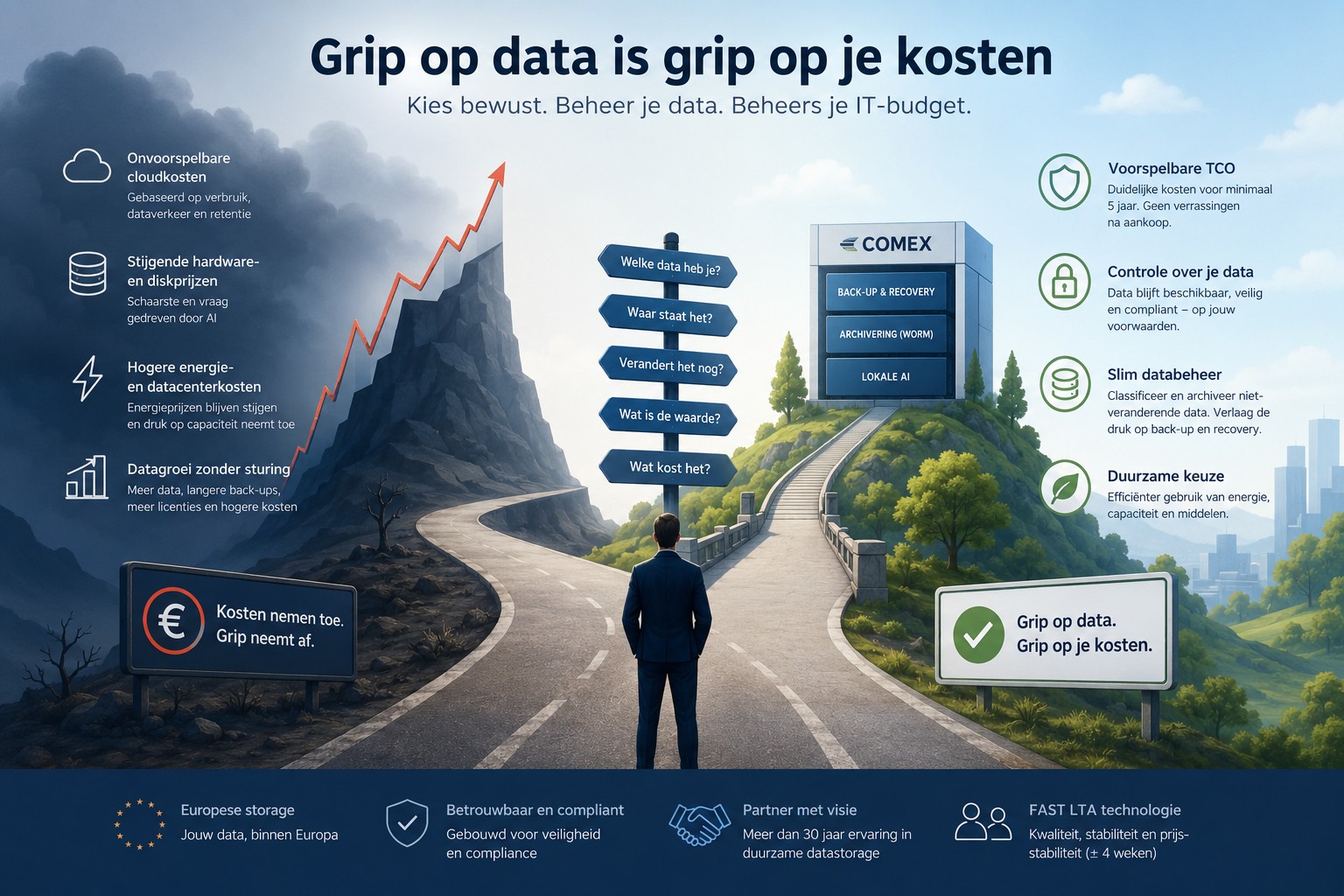
IT budgets are under pressure, specifically due to a combination of developments that reinforce one another. Organizations are storing more data than ever, backups are getting larger, cloud environments continue to expand, and new applications like AI demand extra storage capacity and processing power. Additionally, IT costs continue to rise sharply.
Storage as a strategic cost item
As a result, storage is becoming less of a technical topic and more of a strategic cost item. As long as data continues to grow, costs will grow with it. The question is not just what storage costs today, but primarily how predictable those costs will remain in the coming years.
This is exactly where the friction lies. Many organizations have a grip on their current infrastructure, but much less on how their data evolves. Old project data, closed files, emails, images, reports, and application data often remain part of the same processes for years—even when that data hardly ever changes.
This slowly creates a cost issue. Not through one large invoice that stands out immediately, but through ever-increasing capacity, longer backup windows, extra licenses, more management, and more complex recovery. Data that is no longer actively used continues to contribute actively to the costs.
The role of the cloud
The cloud does not automatically make this issue smaller. Of course, the cloud offers flexibility, scalability, and speed. For many workloads, this is logical and sometimes even necessary. But the cloud is not a license for unlimited growth. Costs depend on usage, retention, data traffic, performance, extra copies, and services billed on a monthly basis.
Furthermore, cloud providers themselves are also facing rising costs. Energy, hardware, data center capacity, and the demand for AI infrastructure are putting the market under pressure. These costs don’t just disappear; they eventually find their way back into rates, contracts, or terms and conditions.
This doesn’t mean the cloud is the wrong choice. It does mean that the cloud only remains affordable and manageable if you know exactly which data belongs there, how long it needs to stay, and what the long-term costs associated with it will be.
The role of hardware
The same honesty applies to hardware. Hardware is also becoming more expensive. Disk prices, component costs, and availability fluctuate more rapidly than they did a few years ago. We need to address this, especially since Comex provides hardware solutions itself.
The nuance lies in predictability. With your own storage, you have a better idea of what to expect upfront. The investment is clear, maintenance costs are transparent, and the Total Cost of Ownership can be accurately calculated for a period of at least five years. After purchase, you won’t suddenly receive a higher monthly invoice just because you read, retrieve, or move more data.
This doesn’t always make hardware the cheapest choice on day one, but it can provide budget peace of mind. This is especially true for data that is critical, needs to be kept for a long time, or grows predictably. In these situations, it’s not just the price per terabyte that matters, but primarily the control over total costs over several years.
Total Cost of Ownership
That is why TCO is becoming more important than the purchase price. The question isn’t: what does this solution cost today? The better question is: what will this data cost us in five years? This calculation should include not just capacity, but also management, support, energy, licenses, growth, recovery, migrations, and dependencies.
In a market where prices move faster, transparency becomes more vital. FAST LTA tries to hold sales prices for as long as possible. Currently, this happens in periods of about four weeks. That might seem short, but in the current component market, it actually provides clarity to customers and partners. No one can completely stop global price increases. What is possible, however, is honest calculation, clear communication, and preventing surprises down the road.
Gains through data classification?
Yet the biggest gains often don’t come from sharper purchasing, but from better data management. Not all data needs to stay in the same backup window. Not all data needs to be on the same expensive tier. And not all data needs to be treated daily as if it is still actively changing.
Many organizations have large amounts of data that rarely or never changes. Think of closed files, research data, project archives, images, administrative documents, or compliance-sensitive information. When this data is actively classified and moved to a suitable WORM archive, you reduce the pressure on backup and recovery.
An archive is therefore not a data graveyard. On the contrary, it is a way to keep data available, secure, and compliant without it unnecessarily weighing down backup capacity, licenses, and recovery processes.
Conclusion
Cost control doesn’t start with the choice between cloud or on-premise. It starts with insight. Which data is still changing? Which data needs to be recoverable quickly? Which data primarily needs to be stored securely and immutably? And which data is currently incurring costs without providing any operational value in return?
Those who don’t have clear answers to these questions will continue to react to growing invoices. Those who do can take the lead.
The future, therefore, does not lie in moving everything to the cloud or everything back to on-premise hardware. The future lies in a conscious hybrid strategy. Cloud where flexibility is needed; own storage where control, predictability, and long-term TCO are paramount.
This prevents storage costs from continuing to rise without a clear reason. And it allows you to maintain a grip on what is becoming increasingly important for every organization: data, budget, and digital autonomy.
 Subscribe for tips and info