+31 (0)43 30 88 400 | office@comex.eu
protecting our society’s digital legacy

Digital archives are the memory of our society. They preserve not only documents, photos, and audiovisual material, but also stories, decisions, collections, and context. What is stored today must remain findable, readable, and reliable decades from now.
That is precisely where the challenge lies. Digital collections grow quickly, file formats change, and storage media become obsolete. What once seemed securely stored can later become difficult to access or even unusable. For archives and heritage institutions, digital preservation is therefore not a one-time IT choice, but an ongoing responsibility.
The pressure on digital collections is increasing
The digital world demands constant attention. Drives and optical media can lose data over time. At the same time, data volumes are increasing, making management, preservation, and migration increasingly complex.
In addition, archivists spend a lot of time describing, organizing, and making digital collections available. Metadata, file formats, access, rights management, and sustainable storage must all be correct. An error in this process can have major consequences for the findability or reliability of a collection years later.
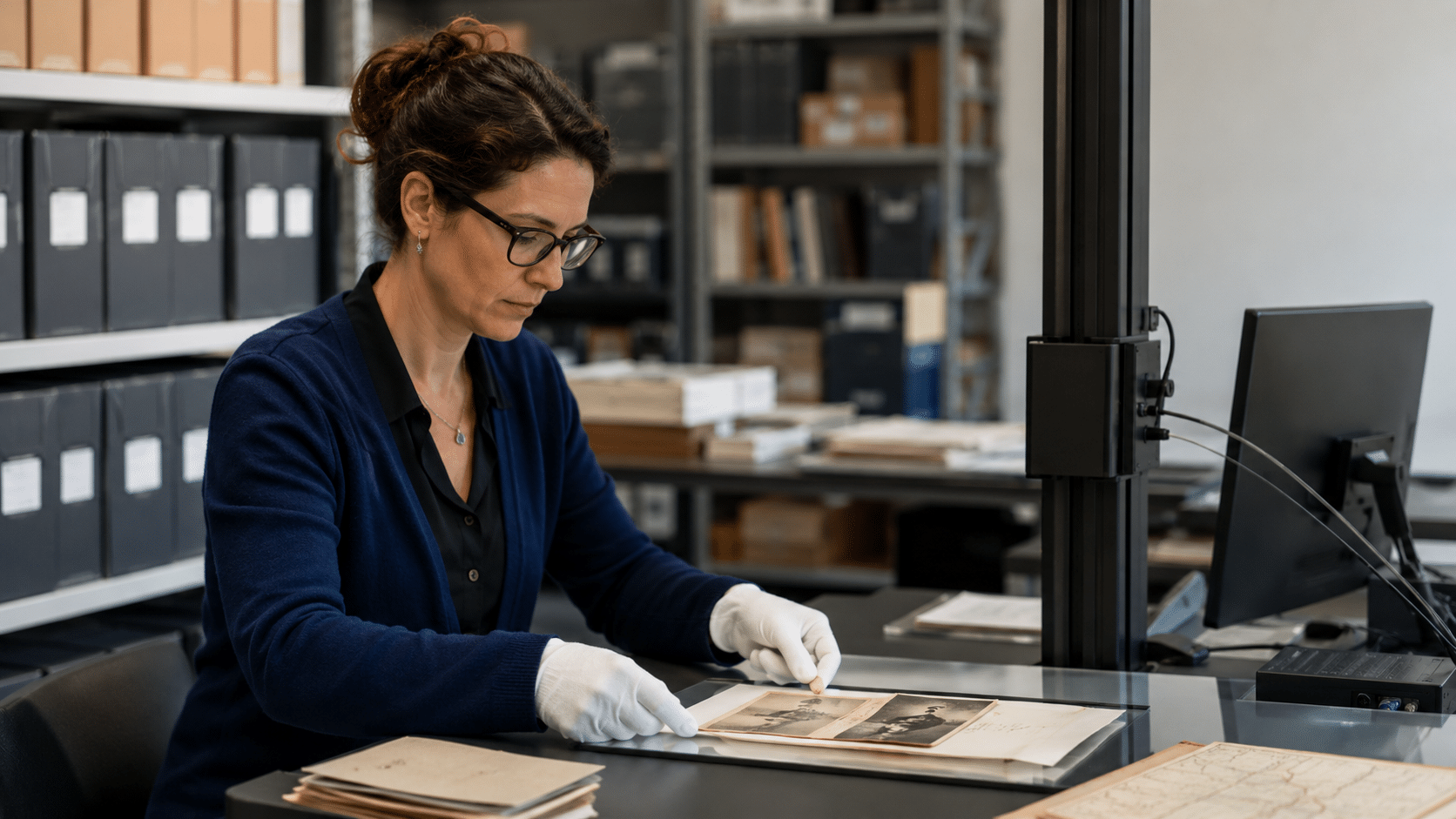
For many archives, the challenge begins even earlier. A large part of paper heritage has not yet, or only partially, been digitized. Think of historical documents, deeds, photos, maps, files, and local collections that are still physically preserved. Digitization makes this material more accessible, but also immediately brings new questions. Where are these digital files stored? How is authenticity guaranteed? And how do you prevent a scanning project from turning into a new digital backlog later on?
This shifts the challenge from preservation to sustainable management. Digitizing is not the endpoint. It is the beginning of a new responsibility: ensuring that digital heritage data remains available securely, findably, and reliably.
AI as a tool for accessibility
AI can help heritage institutions make collections more searchable, usable, and accessible. Not by taking over the work of archivists, but by organizing, recognizing, and enriching large amounts of material more quickly.
Think of automatic text recognition for scanned documents, image recognition for photos, speech recognition for audio recordings, and the automatic completion of metadata. This allows collections to be categorized faster and made more findable. Search queries can also be interpreted more intelligently, allowing researchers, policymakers, and citizens to reach relevant sources more quickly.
Additionally, AI can help improve the readability or usability of historical material. Think of making an old scan more legible, automatically transcribing handwritten text, or converting an audio recording into searchable text. This makes sources more accessible, especially when collections are large and manual processing takes a lot of time.
For archives, an important principle is that AI does not replace the original. An improved scan, transcription, or AI-generated description remains a derivative version. The authentic source file must be preserved untouched. Only then does it remain clear what the original source is and which layer has been added by technology.
AI can therefore primarily add value as a tool for access, interpretation, and enrichment. It not only makes collections findable faster but can also establish connections between documents, persons, locations, and events. This offers new possibilities for research and public disclosure.
But AI also requires control
Yet AI is not a solution you simply layer on top of an archive. Heritage collections regularly contain sensitive information. Think of personal data, copyrights, historical context, or material that can be misinterpreted.
There is also the risk that AI reinforces existing biases. If training data is incomplete or one-sided, the results can be too. For archives, this is extra important because they not only preserve information but also contribute to how future generations understand the past.
That is why AI in the heritage sector is not just about efficiency. It is primarily about control, transparency, and diligence. Which AI tools are being used? Where is the data processed? Are sensitive documents included? And how is it recorded which edits or enrichments have taken place?
Without that control, AI can actually raise doubts about the reliability of heritage data. The power therefore lies not in AI itself, but in AI within a controlled environment. An environment in which source files remain secure, derivative versions are recognizable, and every step is traceable. In this way, AI can increase the accessibility of heritage without compromising the authenticity of the original collection.
Digital preservation requires a solid foundation
Whether it concerns AI, digitization, or long-term preservation, everything starts with reliable storage. A digital archive must be secure, sustainable, and accessible. Not just today, but also in ten, twenty, or thirty years.
This requires storage solutions that suit the nature of archival data. Data that often does not change for years, but must remain demonstrably intact. Data that must be protected against ransomware, human error, and unwanted changes. And data for which organizations must be able to demonstrate that it has been stored reliably and unchanged.
How Comex can help
Comex has been working for archives and heritage institutions for years. At least half of the provincial archives now use one or more of our storage systems. This experience means we know the practice: the combination of long-term preservation, accessibility, compliance, and limited capacity.
With our solutions, we help archives store digital collections sustainably, securely, and verifiably. Think of storage for digital archives, protection against data loss, and support for environments where data must remain available for the long term.
In this way, we form a solid foundation for the next step: the secure use of (local) AI, better metadata, and smarter access to collections, without losing control over valuable heritage data.
Want to know more? View our references on the website and discover how other archives and heritage institutions store their digital collections in a future-proof way.
 Subscribe for tips and info