+31 (0)43 30 88 400 | office@comex.eu
From data classification to active archiving: less pressure on your backup environment

In the previous blog, we looked at the rising pressure on IT budgets. A significant part of that problem lies in data growth. Organizations are storing more and more information, even though not all of that data still changes daily or is actively used.
That is where data classification begins. Only when you know which data is active, which data hardly changes, and which data primarily needs to be kept secure, can you determine where that data belongs. Not all data needs to remain in the same storage environment. And not all data needs to be included in your backup every single time.
This is where active archiving adds value.
What is active archiving?
An archive is still often seen as a final destination—a place where data disappears as soon as no one works with it daily anymore. That image is no longer accurate.
An active archive is an environment where data remains secure, accessible, and controlled. Data that no longer changes is no longer unnecessarily included in daily backup processes, yet remains available whenever needed.
Think of closed files, project data, research data, images, financial documents, or compliance-sensitive information. This data often hardly changes anymore but must be stored reliably for years.
Data classification determines what belongs where
Active archiving starts with insight. Which data is still active? Which data no longer changes? Which data needs to be kept for a long time? And which data must be protected against modification or deletion?
With data classification, you make that distinction. Active data remains in the operational environment. Data that no longer changes, but must remain available and protected, can move to an active WORM archive.
This prevents static data from continuing to put unnecessary pressure on your backup environment.
Less data in backup, less pressure on the environment
Many organizations back up more data than necessary. Not because they consciously chose to, but because environments have grown over the years. Everything stays, everything keeps running, and everything keeps counting.
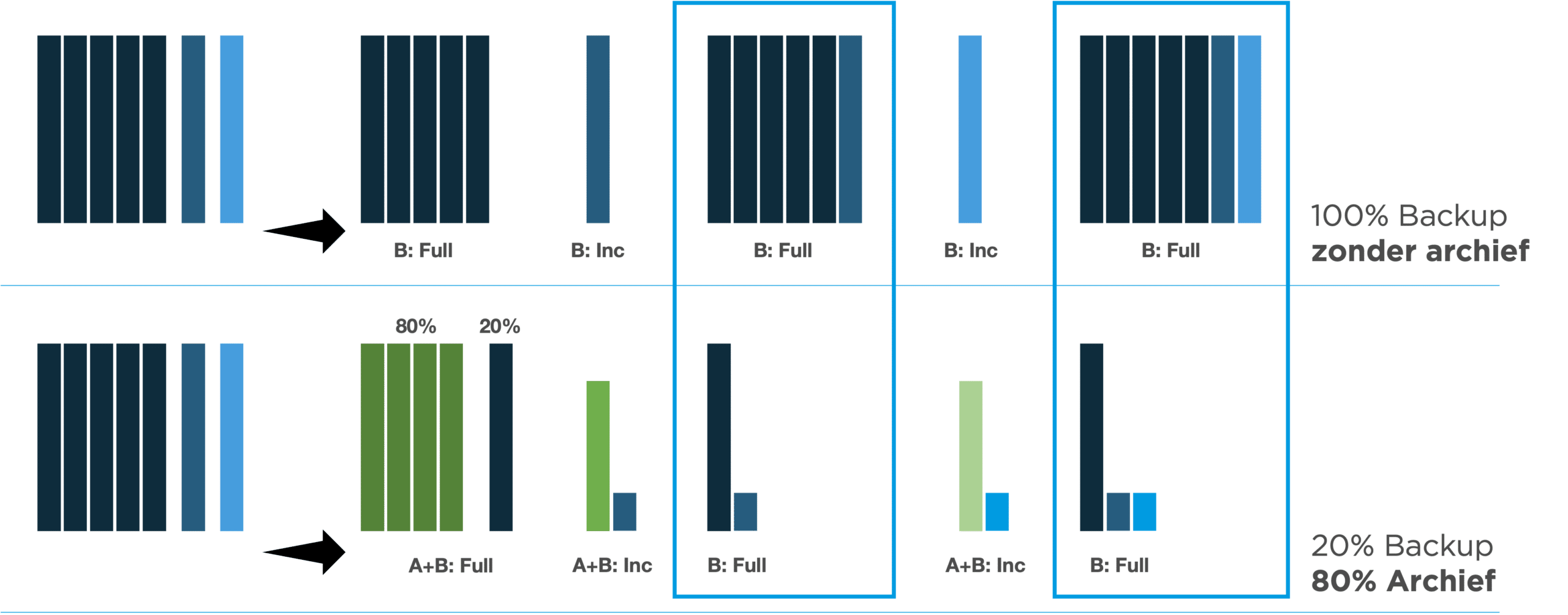
This has consequences. Backup windows become longer, capacity grows, licenses become more expensive, and recovery becomes more demanding. By removing non-changing data from the backup window, you reduce the pressure on the entire environment.
This does not mean that data is less protected. In fact, you protect data in a way that better suits its use. Active data belongs in your backup strategy. Non-changing data that must be stored securely and demonstrably belongs in your archiving strategy.
The effect on costs, management, and recovery
Active archiving helps make costs more manageable. You reduce the amount of data that needs to be processed, protected, and restored daily. As a result, backup processes become smaller and more manageable.
This separation also helps during incidents. In the event of ransomware, human error, or technical disruptions, you want to be able to focus quickly on systems and datasets that require operational recovery. Archive data remains secure and available but does not need to go through the same recovery process unnecessarily.
Furthermore, Silent Cubes offer the advantage that archived data does not need to be restored at all during a ransomware attack because it is stored on the system as immutable and undeletable.
Why WORM is important
For many organizations, archiving is not just about costs. It is also about compliance, integrity, and demonstrability.
WORM stands for Write Once, Read Many. Data is recorded and cannot simply be modified or deleted thereafter. This helps organizations store information in a demonstrably complete and unchanged manner.
With an active WORM archive, you therefore reduce the pressure on backup, capacity, and management, while important data remains secure, accessible, and compliant.
Gaining control over costs starts with the right place for data
Storage costs are not just driven by the price per terabyte. They are primarily caused by the way data is managed. If active data, old data, compliance data, and archive data are all treated the same, the environment naturally becomes more expensive and complex.
With data classification, you make the distinction. With active archiving, you give that practical implementation.
This prevents your backup environment from continuing to grow with data that no longer belongs there. You reduce the pressure on capacity, licenses, management, and recovery. At the same time, important data remains stored securely, accessibly, and compliantly.
This makes active archiving a practical step toward greater control over costs, availability, and data.
 Subscribe for tips and info