+31 (0)43 30 88 400 | office@comex.eu
Volume of data is growing explosively. Think about your storage!

[Download the white paper on strategic cost management here]
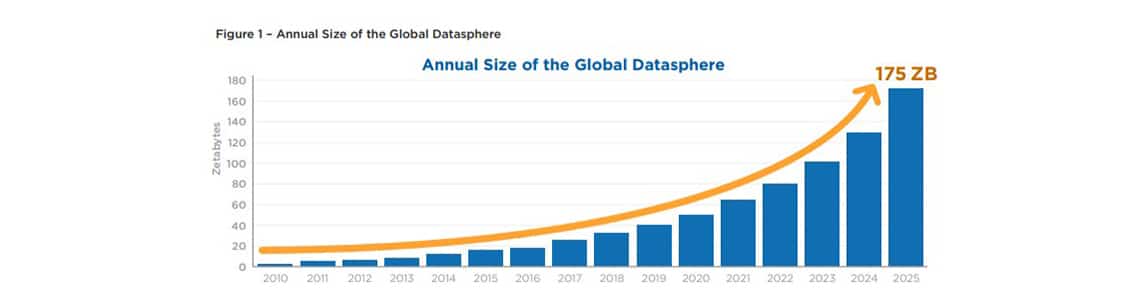
The amount of data is growing exponentially. In 2019, according to IT research firm IDC, we had about 40 zettabytes (ZB), or 40 billion terabytes. You read that correctly: 40 billion. The prediction is that by 2025 we will have grown to 175 zettabytes. That is estimated to be as many bits as grains of sand on the earth. Or if you were to burn all this data onto DVDs and then stack the DVDs, you could go to the moon 23 times.
Gigantic data growth requires storage choices
Left or right, 175 zettabytes is a huge amount of data and it is expected that there will be problems making the capacity available in the foreseeable future. Now there is plenty of storage available from cloud providers and storage services, for example, but at some point this storage will become scarce and therefore expensive. That justifies research into a variety of other forms of storage. However, that is still a long way off. Until these new technologies are developed and launched, the price of storage will rise.
Rising prices make storage strategy more important
The purchase of storage hardware will become more expensive, but more importantly, cloud services will also become more expensive. After all, they too must buy storage and make it available. As an organization, the key is to handle this scarcity well and store data intelligently. You do this, for example, by not betting on one horse: stay flexible, even given the costs. We additionally see that smaller cloud providers are struggling at this time. This is because the larger cloud services want to bring in customers now, even though they earn nothing (or even make a loss) on the cloud storage component. It is a long-term vision.
Think beyond just extra capacity
When purchasing new storage today, people often look first at capacity and price per terabyte. That is logical, but not sufficient. With growing data, you must also think about retention periods, recoverability, archiving, energy consumption, and dependency on cloud storage.
Not all data needs to remain on primary storage. Data that is rarely used but must be preserved can often be better moved to a separate archive or cold storage layer. This keeps primary systems lighter and ensures costs remain more manageable.
For organizations with a lot of data to be kept for long periods, compliant digital archiving is a logical step. Think of data that must remain secure, findable, and sometimes demonstrably unchangeable.
Cloud storage also requires a long-term vision. Cloud can be convenient, but with large amounts of data, costs and dependency can mount. That is why more and more organizations are looking at a cloud exit strategy for specific datasets.
Silent Bricks is suitable for backup, recovery, VTL, and air gap storage. Silent Cubes was developed for compliant digital archiving and WORM storage. Which solution fits depends on the role of your data.
Discuss your storage challenge
Is your data growing faster than your storage strategy? Then it is time to look at which data belongs where.
Schedule a conversation with one of our experts. We can help you think about backup, archive, cold storage, cloud dependency, and cost control.
 Subscribe for tips and info